DI U RITUNDU

During times of universal deceit, telling the truth becomes a revolutionary act. George Orwell

samedi 7 juin 2008

Jan Egeland : le changement climatique est déjà une réalité


Oscillations du niveau du lac Faguibine


GLOBALIS

Jan Egeland, conseiller spécial du Secrétaire général des Nations Unies, actuellement en déplacement au Sahel, nous livre son journal de voyage. Sécheresse persistante, anomalies climatiques, baisse du débit du Niger, conflits armés pour les ressources, présence de trafiquants colombiens : au coeur de l’Afrique, de Ouagadougou à Tombouctou, la mondialisation et le changement climatique sont à l’oeuvre et fragilisent les pays qui sont parmi les plus deshérités de la planète.


1ère journée : Ouagadougou

« Un débat très académique est en cours actuellement en Europe : on se demande encore si "le climat est déjà en train de changer" et si "le changement climatique est visible aujourd’hui". Ici, au Burkina Faso, ce débat n’a pas lieu, parce que les conséquences parlent déjà d’elles-mêmes ».

« Bien que nous ayons passé la journée [du 2 juin] à rencontrer les représentants du gouvernement et le personnel des Nations Unies, cela m’a ouvert les yeux, surtout les discussions que j’ai eues avec les ministres de l’Agriculture et de l’Environnement. Tous ceux que j’ai rencontrés m’ont donné une kyrielle d’exemples de la manière dont tout ce qui a à voir avec le climat et les précipitations au Burkina Faso a atteint des extrêmes ces 10 dernières années ».

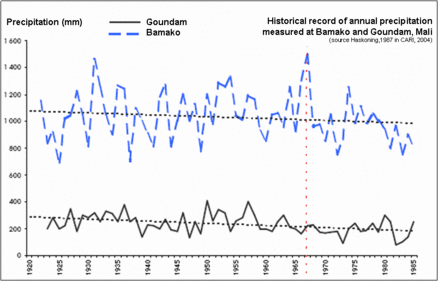
« Le changement climatique au Burkina Faso ne se traduit pas par une réduction des précipitations, mais par leur plus grande imprévisibilité. Et le climat général est devenu bien plus extrême dans sa manière de se manifester : la chaleur, le froid, les hauts et les bas en matière de précipitations ».

« Les populations ne peuvent pas prédire quand la pluie va tomber. Et quand elle tombe, il pleut des cordes. L’année passée, le Burkina Faso a enregistré huit précipitations de plus de 150 millimètres : cela veut dire qu’il y a eu huit inondations dévastatrices dans une période de quatre mois ».

« L’alternative aux inondations est, en fait, une absence de précipitations : c’est tout ou rien, et dans tous les cas, cela se traduit par une crise, de façon complètement imprévisible, pour des populations qui comptent parmi les plus pauvres du monde ».

« J’ai appris aujourd’hui que dans des régions où il ne pleuvait auparavant jamais, les populations enterraient leur argent dans la terre pour le conserver, n’ayant pas accès aux banques. Or, l’année dernière, lorsque des pluies torrentielles se sont abattues sur certaines de ces régions, la terre s’est transformée en bourbier et l’argent [enterré] a été emporté par les eaux de crue, avec les maisons des habitants et le reste de leurs biens ».

« [Cette anecdote] est un bon exemple de la bizarrerie des nouvelles réalités auxquelles les populations de ce pays se trouvent confrontées à mesure qu’elles se trouvent aux prises avec des conditions climatiques qu’elles n’avaient jamais connues jusqu’ici ».

« Une autre retombée importante concerne l’agriculture, bien sûr. Les habitants plantent au moment où la pluie doit commencer à tomber, et puis, rien ne tombe, ou bien les pluies sont très peu abondantes, alors les pousses finissent par se dessécher et mourir. Et puis soudain, de violentes averses s’abattent, qui provoquent une inondation et tout est emporté par les eaux ».

« Ce qui m’a également ouvert les yeux, aujourd’hui, ç’a été de prendre connaissance des statistiques qui m’ont été présentées par le gouvernement, et selon lesquelles le Burkinabè moyen émet 0,38 tonne de CO² par an. Le Chinois moyen en émet 10 fois plus, un Britannique 30 fois plus et les Américains 75 fois plus par habitant ».

« Et de découvrir que le Burkina Faso émet en tout 4,5 millions de tonnes de CO² par an, tandis que le Canada en déverse 747 millions de tonnes, pour une population à peu près équivalente ».

« Cela illustre un problème moral important : ceux qui ne contribuent pas au réchauffement climatique font les frais des changements que ce phénomène engendre, tandis que ceux qui l’ont causé s’en sortent bien. En d’autres termes, les pays du nord commettent des meurtres en toute impunité ».


« La situation est-elle désespérée ? Absolument pas. Les membres du gouvernement et des Nations Unies que j’ai rencontrés ici aujourd’hui m’ont fait clairement comprendre que le Burkina Faso avait besoin d’investissements. Le pays pourrait produire bien plus de vivres, s’il recevait de l’aide sous forme de semences, d’engrais et de systèmes d’irrigation plus performants, en plus grande quantité ».

« Le ministre des Affaires étrangères a expliqué que le pays avait également besoin d’aide en matière de production d’énergie et de reforestation. Je vais m’efforcer de trouver, dans les prochains jours, des exemples concrets de solutions possibles ».

« Malheureusement, ce qu’on m’a fait remarquer à juste titre, c’est qu’à ce jour, les palabres sont allés bon train sur l’aide à apporter aux pays en voie de développement pour leur permettre de faire face au changement climatique, mais que ces paroles ne se sont guère traduites en actes ».

« [Les gens] sont désillusionnés, et c’est vraiment honteux, parce qu’ils n’ont rien fait pour se mettre dans une telle situation, et nous qui avons causé ce problème en ignorons les conséquences parce qu’elles ne nous concernent pas ».

« Demain [le 3 juin], nous poursuivons notre voyage au Mali, où d’autres rencontres sont prévues à Bamako, avant de nous rendre à Faguibine, un lac asséché situé près de Tombouctou, où il sera intéressant d’observer le changement climatique par nous-mêmes ».
2ème journée : Bamako


« Trop de Maliens ont recours aux armes pour résoudre leurs griefs, à mesure que la croissance démographique galopante, l’épuisement progressif des ressources en eau et la détérioration des terres agricoles et pastorales transforment les voisins en ennemis à travers les vastes régions de cette vieille contrée ».

« Selon mes collègues des Nations Unies qui se trouvent ici, à Bamako, la capitale, des centaines de petits conflits, relativement localisés, font rage à travers le Mali ».

« Et les représentants du service des armes légères de la Communauté économique des Etats de l’Afrique de l’Ouest (CEDEAO) m’ont dit que des armes affluaient actuellement ici ; elles proviennent de plusieurs autres pays de la région, qui ont mis fin dernièrement à leurs propres guerres. Selon la CEDEAO, le nombre des fabricants d’armes locaux a également doublé ces quatre ou cinq dernières années au Mali ».

« Ce fut d’ailleurs une révélation assez émotionnelle, pour moi. La dernière fois que j’ai travaillé au Mali, c’était il y a 10 ans, pour le compte des ONG [organisations non-gouvernementales] et du gouvernement norvégiens ; j’avais participé à la négociation d’un moratoire sur les armes légères. À l’époque, la rébellion des Touaregs du nord venait de s’achever et le Mali était encore inondé d’armes légères, qui avaient afflué dans le pays après la fin d’autres conflits africains et de la Guerre froide ».

« Aujourd’hui, les institutions que nous avions créées pour appliquer le moratoire et retirer ces armes de la circulation, notamment la Commission nationale sur les armes légères, existent encore mais elles se débattent avec des fonds et un soutien qui sont loin d’être suffisants. Ces institutions et ce moratoire sont tout aussi essentiels aujourd’hui qu’ils l’étaient il y a 10 ans ».

« Mais pour mettre un terme à ces affrontements, actuellement limités et isolés, il ne suffira pas de retirer ces armes des mains du peuple ».

Le changement climatique, source de conflits


« J’ai entendu aujourd’hui [le 3 juin] le président Amadou Toumani Touré, le Premier ministre ainsi que d’autres hauts responsables, dont les propos rejoignent ceux que j’ai entendus hier au Burkina Faso -pays voisin, situé à l’est du Mali et où j’ai commencé cette tournée d’une semaine dans le Sahel. Ils m’ont parlé de la diminution et de l’imprévisibilité des précipitations, des pénuries d’eau et de l’avancée progressive du désert du Sahara sur les terres arables du Mali et le fleuve Niger, autant de facteurs qui contraignent les communautés agricoles et pastorales à empiéter sur leurs territoires respectifs et provoquent des affrontements fréquents ». « Les éleveurs du nord du Mali, où je me rends demain, se sentent apparemment très en marge, eux aussi, du processus de développement en cours dans le sud du pays, une autre source de tension. Dans cette région, certains membres de l’ethnie des Touaregs ont lancé une rébellion, revendiquant l’égalité politique et économique du nord ».

« De même, nous avons évoqué les souffrances des Maliens face à la hausse du prix du riz, et la production de coton, principale culture de rente du pays, décimée par des pluies imprévisibles ».

Les trafiquants de drogue colombiens

« Il semble que les trafiquants de drogue colombiens, qui disposent de fonds illimités pour soudoyer [les populations], payent et se battent pour obtenir le contrôle des itinéraires transsahariens qui leur permettent d’acheminer leurs drogues vers l’Europe et jusqu’au Golfe. Ils sapent [l’autorité du] gouvernement et font régner l’insécurité dans une bonne partie du pays. Je connais, pour avoir travaillé en Colombie, les troubles causés par ces gangs, et je sais combien il est difficile de les déloger une fois qu’ils se sont établis quelque part ».

« Tout ce que j’ai vu et entendu au Mali a confirmé l’impression que j’avais déjà, à savoir qu’on ignore encore s’il y aura davantage de coopération ou davantage de conflits au Sahel. Nous pouvons contribuer à investir dans la coopération ».

« Il y a des gens, ici, qui préconisent un recours à l’armée pour mettre fin aux rébellions, aux attaques armées et à la contrebande. L’armée est certainement une solution contre la contrebande et le trafic de drogue, mais les griefs sociaux, politiques et culturels légitimes ne peuvent être réglés de cette façon. C’est par les investissements, le développement et le dialogue qu’on parviendra à les résoudre ».

Soutien des bailleurs et des Nations Unies

« Je vais par conséquent encourager les bailleurs, qui ont déjà soutenu un grand nombre de bons programmes, ici, à Bamako, à consacrer des fonds bien plus importants au financement des programmes environnementaux et aux projets destinés à aider et à autonomiser les éleveurs, surtout. Ils doivent également soutenir les programmes de retrait des armes légères ».

« Nous avons également convenu que les Nations Unies pourraient et devraient en faire davantage pour favoriser la réconciliation au plan local, le développement local et l’autonomisation des agriculteurs et des communautés agricoles du nord, ainsi que des éleveurs ».

« La situation est déjà très tendue. Mais nous pouvons prévenir un conflit plus grave en injectant les investissements nécessaires et en coopérant. Le président du Mali a pris une position tout à fait admirable en faveur d’un dialogue avec toutes les communautés marginalisées. Avec les voisins du Mali, il organise actuellement une conférence régionale sur la paix et la sécurité qui devrait commencer en juin ou en juillet, semble-t-il ».

« À présent, cap sur Tombouctou, cette cité ancestrale où se trouve le lac Faguibine ; au lac, je pourrai constater par moi-même l’impact du changement climatique et, je l’espère, imaginer des solutions créatives pour y faire face ».
3ème journée : Tombouctou

« Il y a tellement de sceptiques du climat dans le monde, et moi-même j’en faisais plus ou moins partie, dans le sens où je n’en voyais pas déjà la preuve lorsque j’ai commencé ce voyage. Mais je pense qu’après ce que j’ai vu aujourd’hui, je suis sans aucun doute en train de changer d’avis ».

« La journée a été longue : elle a commencé avec la sonnerie du téléphone, à 5 h 15 du matin dans mon hôtel, à Tombouctou, dans le nord du Mali, et déjà, il faisait bien plus de 30 degrés dehors ».

« Une fois de plus, nous avons grimpé dans un convoi bien trop long, mais cette fois, pour la bonne cause : tous les parlementaires locaux, les autorités locales et les représentants des communautés nomades ont voulu se joindre à nous sur notre route vers les communautés qui vivent au cœur de la région du lac Faguibine, un des principaux symboles du changement climatique au Sahel ».


« On a dû s’arrêter peut-être 10 fois en chemin vers le lac. Le fleuve Niger lui-même est moins profond [qu’il ne l’était auparavant] et n’alimente donc plus les anciens cours d’eau navigables ; c’est pourquoi une bonne partie de la région antique de Tombouctou est aujourd’hui complètement asséchée, jusqu’à l’immense lac Faguibine compris ».

« Nous avons vu des travailleurs qui s’efforçaient de creuser un nouveau canal, là où passaient auparavant les eaux du fleuve Niger, aujourd’hui évaporées en raison d’un ensemble de facteurs : changement climatique, détérioration de l’environnement et désertification ».

« C’était émouvant de rencontrer tellement de gens, qui ont tous dit “c’est une lutte entre la vie et la mort pour nous”, et de voir combien les gens sont certains qu’avec juste des sources d’eau fiables, cette région brûlée par le soleil pourrait redevenir le grenier du Mali. Sur le lit des anciens lacs, ils mènent encore beaucoup d’activités agricoles, mais bien entendu, ce n’est qu’une question de temps avant que tout s’assèche, et puis ce sera la fin pour toutes les sociétés nomades et pastorales de la région ».

« Lorsque nous sommes arrivés au lac Faguibine, il y avait une grande réunion, qui rassemblait tous les chefs communautaires. L’un d’entre eux m’a lancé un vibrant appel, dont je me souviendrai toujours. Il m’a dit : “Je suis orphelin de ce lac mort parce que j’ai vécu et me suis épanoui sur ses rives lorsque c’était encore un endroit merveilleux pour les pêcheurs, les agriculteurs et les éleveurs”. Il s’est avéré que cette personne était l’un des premiers Touaregs de la région ».

« Ce qui s’est passé ici revient en fait, en termes d’échelle, à voir le Lake District, en Angleterre, s’assécher au bout de quelques siècles ; à ceci près qu’au Mali, des centaines de milliers de personnes dépendent des lacs pour vivre ».

Retourner la situation

« Mais que faudrait-il pour retourner la situation ? Pas grand-chose ! Avec juste quelques machines, ils creusent déjà chaque année des kilomètres de nouveau canal, et plusieurs villages ont de nouveau de l’eau, au moins deux ou trois mois par an. Le Programme alimentaire mondial a contribué au prolongement du canal, grâce à ses programmes travail contre nourriture, par le biais desquels des hommes, qui seraient autrement au chômage, peuvent travailler à la construction du canal et planter des arbres en échange de rations alimentaires ».

« Le gouvernement allemand soutient ce projet, mais peu d’autres bailleurs de fonds internationaux le font. Or, sans nouvelles ressources, le projet de restauration du lac Faguibine ne pourra se poursuivre au-delà de quelques mois. Aujourd’hui, le message s’adresse en fait [aux leaders du] sommet de Copenhague, qui se tiendra à la fin de l’année ».

« Lorsque tous les leaders du monde seront là, nous devrons [leur] demander s’il convient réellement de laisser des projets vitaux comme celui-ci, qui sont directement liés au changement climatique, manquer de financement. Ce serait vraiment un échec moral si les projets qui existent déjà dans le domaine de l’aide aux populations touchées par le changement climatique n’étaient pas financés par les pays industrialisés qui sont responsables de ce phénomène ! ».

« En tout, nous avons roulé de six heures du matin à six heures du soir, avec plus d’une dizaine de réunions et d’arrêts. Ce soir, nous reprenons l’avion pour retourner à Bamako, avant de nous rendre au Niger, demain matin, où nous rencontrerons le Président. Enfin, nous irons voir un autre lac desséché : le lac Tchad ».

vendredi 6 juin 2008

अल थे वेस्टर्न वे

http://edition.cnn.com/video/?/video/world/2008/06/05/mates.india.food.itn


Forty years after RFK's assassination, Barack picks up where Bobby left off." />

Mother Jones

James Ridgeway" />
June 05" /> , 2008" />

It would be easy to make too much of the similarities between Robert F. Kennedy, who died on the night when the Democratic presidential nomination came within his grasp, 40 years ago today, and Barack Obama, who has just firmly taken hold of it. The times are different, and so are the men. But then again.

Hope, like greatness, is a thing some men have thrust upon them. They emerge as repositories for the finer yearnings of a confused and bitter nation, a mirror in which we see ourselves reflected not as the people we are, but as the people we would like to be—and may, because of them, inch slightly closer to becoming. Whether or not they are worthy of such faith is, in the end, less important than the fact that they inspire us to be more worthy ourselves.

This is why it's a mistake to dismiss Obama as being "only" inspirational. Despite the example set by our current president, competence is not all that difficult to come by in Washington, DC. (In fact, our permanent civil service could get most things done much more effectively without any political leadership at all.) But someone who can make us believe that this country of ours might actually pull itself together and become a little bit more compassionate or a little bit more just, someone who encourages us to dedicate ourselves to that goal rather than to just lowering our taxes or paying less for gasoline—that's something found far more rarely inside the Beltway.

For my generation, I suppose that someone was Bobby Kennedy, though I'm not sure I realized it at the time. On the war, there wasn't much difference between Kennedy and his rival on the left, Eugene McCarthy. They both wanted to get us out of Vietnam. VP Hubert Humphrey may have been the insider candidate, but he came out of the highly progressive Minnesota Democratic-Farmer-Labor Party (as did McCarthy, and late Senator Paul Wellstone), and hewed to a liberal platform that would seem radical by the standards of today's post-Democratic Leadership Council Democratic Party. By contrast, Bobby Kennedy, in many ways, had only recently evolved into a true progressive. And some saw Kennedy, who got into the race only after Lyndon Johnson's poor performance in the New Hampshire primary, as an opportunist who was strong on rhetoric but short on substance.

Even Kennedy's most visible virtue, his deep concern for the poor, had its problems. The Kennedy poverty program, run by Sargent Shriver and taken up by Lyndon Johnson after Jack Kennedy's assassination, quickly became a pork-barrel operation. In Chicago, for example, millions of federal dollars were pumped into Mayor Richard Daley's machine. None of the programs were conceived to threaten the status quo, which made them too tame for a lot of activists in the late 1960s. They were bootstrap projects, where the government would provide the poor with job training, education, and health care to help them elevate themselves to a point where they could jump off into the middle class. For the most part, this never happened.

Two parts of the poverty program—Head Start, the program for young children, and Neighborhood Legal Services, which provides free legal assistance to low-income residents—did prove lasting and truly valuable. And some funds managed to filter through to the likes of Saul Alinsky, the legendary community organizer on the South Side of Chicago who advocated confrontation with the Daley machine, and encouraged his groups to engage in civil disobedience if need be. (Alinsky himself, however, knew how to work the system when he needed to. He reminded me of an old-school labor organizer—talking tough but in the end always willing to cut a deal in the back room. And I can remember radicals attacking him for his lack of revolutionary fervor, in the same way, incidentally, they attacked Ralph Nader, who was seen as a patsy for the legal profession. "A guy has to be a political idiot," Alinsky scoffed at radicals back then, "to say all power comes out of the barrel of a gun when the other side has the guns."

Saul Alinsky believed that power flowed up from the streets and was there for the taking, if only people believed they could do so. By 1968, Bobby Kennedy had taken up the idea of "decentralization" (in part, as an alternative to welfare), championing a new Community Action Program (not unlike a more radical model advanced by Students for a Democratic Society), which would allow federal anti-poverty projects—and funds—to be run by the populations they served.

Maybe that had something to do with what began to happen during Bobby Kennedy's brief presidential campaign, when he went out into the streets in the spring of 1968. Or maybe it was just something about the man. My friend Jack Newfield, the late Village Voice reporter, used to say that Kennedy was more priest than politician. Newfield often accompanied Kennedy during a campaign that took him to Indian reservations, into Appalachia, through Brooklyn's Bedford Stuyvesant or East L.A., to small gatherings with family farmers, to classrooms where he sat down and talked with children as if they were actual human beings. Newfield recalled that on a trip through Watts a few days before RFK's death, "He said to me, 'I want you to see what I see. And I see this ecstasy in the eyes of blacks and Mexican Americans.'" The television cameras saw it, too, as they followed him to places they usually wouldn't dream of going, and millions of Americans in their living rooms saw it. You can still see it today, in the old footage—as he walks or rides through the urban streets, people reached out to touch him as they would a talisman, as if the touch alone would empower and dignify them.

Next page: "As he lay dying on the floor of the Ambassador Hotel kitchen pantry..."

As he lay dying on the floor of the Ambassador Hotel kitchen pantry, his head was cradled by a Mexican American busboy. The previous day the same busboy, Juan Romero, had delivered room service to Kennedy. "He shook my hand as hard as anyone had ever shaken it," Romero later said. "I walked out of there 20 feet tall, thinking, 'I'm not just a busboy, I'm a human being.' He made me feel that way."

People like to talk about populism and change, but in the world of gritty American politics, where parties are locked in a petty and intractable clench, change seldom takes place. The people around Kennedy felt he was on the leading edge to a new world. Yet the actual policy changes Bobby Kennedy proposed were modest—for the most part, slightly better versions of the kinds of plans for jobs, health care, or environmental protection that Democrats are still floating today. His approach, however, was something else. When doctors asked Kennedy who was going to pay for improved medical care, he replied, "You will." He told corporate executives they had a moral responsibility to the citizenry. He insisted leaders take responsibility for their actions. George W. Bush is not his type of guy.

In a speech given a few days after the assassination of Dr. Martin Luther King Jr., and two months before his own, Kennedy said:

We know what we must do. It is to achieve true justice among our fellow citizens. The question is not what programs we should seek to enact. The question is whether we can find in our own midst and in our own hearts that leadership of humane purpose that will recognize the terrible truths of our existence.

We must admit the vanity of our false distinctions among men and learn to find our own advancement in the search for the advancement of others. We must admit in ourselves that our own children's future cannot be built on the misfortunes of others. We must recognize that this short life can neither be ennobled or enriched by hatred or revenge.

Our lives on this planet are too short and the work to be done too great to let this spirit flourish any longer in our land. Of course we cannot vanquish it with a program, nor with a resolution.

But we can perhaps remember, if only for a time, that those who live with us are our brothers, that they share with us the same short moment of life; that they seek, as do we, nothing but the chance to live out their lives in purpose and in happiness, winning what satisfaction and fulfillment they can.

Surely, this bond of common faith, this bond of common goal, can begin to teach us something. Surely, we can learn, at least, to look at those around us as fellow men, and surely we can begin to work a little harder to bind up the wounds among us and to become in our own hearts brothers and countrymen once again.

Barack Obama's speechwriters must have studied this speech and others like it. Yet it means something—even if it does not mean everything we would wish—that words and sentiments like Bobby Kennedy's sound plausible coming from the lips of Obama, as they would from few other politicians I can think of.

Obama is no populist, either, in any meaningful sense of the word; his proposals for change are modest, and his movement about as thin as Bobby Kennedy's. He is a shrewd politician, appealing to the grassroots but also willing to deal with powerful corporate interests, just as Kennedy dealt with the machine politics of Mayor Daley and his ilk, knowing that he could not win without them. But Obama has something close to the same sense of public duty that Bobby Kennedy had. And somewhere inside his chest there seems to be a beating human heart, which is something we haven't had in the White House for a good long time.

James Ridgeway is Mother Jones' senior Washington correspondent.

how the Muslim critique of materialism helps to rediscover the sacred spirituality of Islam and explain the decline of the वेस्ट

Prince Charles' Latest Speech on Islam

On Friday, December 13th, at Wilton Park, the Prince of Wales explained how the Muslim critique of materialism helped him to rediscover the sacred spirituality of Islam and explain the decline of the West.


"I start from the belief that Islamic civilization at its best... has an important message for the West in the way it has retained an integrated and integral view of the sanctity of the world around us.
I feel that we in the West could be helped to rediscover the roots of our own understanding by an appreciation of the Islamic tradition's deep respect for the timeless traditions of the natural order.

I believe that process could help in the task of bringing our two faiths closer together. It could also help us in the West to rethink, and for the better, our practical stewardship of man and his environment in fields such as health-care, the natural environment and agriculture, as well as in architecture and urban planning.

Modern materialism is unbalanced and increasingly damaging in its long-term consequences. Yet nearly all the great religions of the world have held an integral view of the sanctity of the world. The Christian message with, for example, its deeply mystical and symbolic doctrine of the Incarnation, has been traditionally a message of the unity of the worlds of spirit and matter, and of God's manifestation in this world and in mankind.

But during the past three centuries, in the Western world at least, a dangerous division has occurred in the way we perceive the world around us. Science has tried to assume a monopoly even a tyranny over our understanding. Religion and science have become separated, so that now, as Wordsworth said, "Little we see in nature that is ours". Science has attempted to take over the natural world from God; it has fragmented the cosmos and relegated the sacred to a separate and secondary compartment of our understanding, divorced from practical, day to day existence.

We are only now beginning to gauge the disastrous results. We in the Western world seem to have lost a sense of the wholeness of our environment, and of our immense and inalienable responsibility to the whole of creation. This has led to an increasing failure to appreciate or understand tradition and the wisdom of our forebears, accumulated over the centuries. Indeed, tradition is positively discriminated against us if it were some socially unacceptable disease.

In my view, a more holistic approach is needed now. Science has done the inestimable service of showing us a world much more complex than we ever imagined. But in its modern, materialist, one-dimensional form, it cannot explain everything. God is not merely the ultimate Newtonian mathematician or the mechanistic clockmaker. As science and technology have become increasingly separated from ethical, moral and sacred considerations, so the implications of such a separation have become more sombre and horrifying we see in genetic manipulation or in the consequences of the kind of scientific arrogance so blatant in the scandal of BSE.

I have always felt that tradition is not a man-made element in our lives, but a God-given intuition of natural rhythms, of the fundamental harmony that emerges from the union of the paradoxical opposites that exist in every aspect of nature.... That is why I believe Man is so much more than just a biological phenomenon resting on what we now seem to define as "the bottom line" of the great balance sheet of life, according to which art and culture are seen increasingly as optional extras in life.

This view is quite contrary, for example, to the outlook of the Muslim craftsman or artist, who is never concerned with display for its own sake, nor with progressing ever forward in his own ingenuity, but is content to submit a man's craft to God. That outlook reflects, I believe, the memorable passage in the Koran, "whithersoever you turn there is the face of God and God is all-Embracing, all-Knowing". While appreciating that this essential innocence has been destroyed, and destroyed everywhere, I nevertheless believe that the survival of civilized values, as we have inherited them from our ancestors, depends on the corresponding survival in our hearts of that profound sense of the sacred and the spiritual.

Traditional religions, with their integral view of the universe, can help us to rediscover the importance of the integration of the secular and the sacred. The danger of ignoring this essential aspect of our existence is not just spiritual or intellectual. It also lies at the heart of that great divide between the Islamic and Western worlds over the place of materialism in our lives. In those instances where Islam chooses to reject Western materialism, this is not, in my view, a political affectation or the result of envy or a sense of inferiority. Quite the opposite. And the danger that the gulf between the worlds of Islam and the other Eastern religions on the one hand and the West on the other will grow ever wider and more unbridgeable is real, unless we can explore together practical ways of integrating the sacred and the secular in both our cultures in order to provide a true inspiration for the next century.

Islamic culture in its traditional form has striven to preserve this integrated, spiritual view of the world in a way we have not seen fit to do in recent generations in the West. There is much we can learn from that Islamic world view in this respect.

There are many ways in which mutual understanding and appreciation can be built. Perhaps, for instance, we could begin by having more Muslim teachers in British schools, or by encouraging exchanges of teachers. Everywhere in the world people want to learn English. But in the West, in turn, we need to be taught by Islamic teachers how to learn with our hearts, as well as our heads. The approaching millennium may be the ideal catalyst for helping to explore and stimulate these links, and I hope we shall not ignore the opportunity this gives us to rediscover the spiritual underpinning of our entire existence.

We are only now beginning to gauge the disastrous results. We in the Western world seem to have lost a sense of the wholeness of our environment, and of our immense and inalienable responsibility to the whole of creation. This has led to an increasing failure to appreciate or understand tradition and the wisdom of our forebears, accumulated over the centuries. Indeed, tradition is positively discriminated against ­ as if it were some socially unacceptable disease.

In my view, a more holistic approach is needed now. Science has done the inestimable service of showing us a world much more complex than we ever imagined. But in its modern, materialist, one-dimensional form, it cannot explain everything. God is not merely the ultimate Newtonian mathematician or the mechanistic clockmaker. As science and technology have become increasingly separated from ethical, moral and sacred considerations, so the implications of such a separation have become more sombre and horrifying ­ as we see in genetic manipulation or in the consequences of the kind of scientific arrogance so blatant in the scandal of BSE.

I have always felt that tradition is not a man-made element in our lives, but a God-given intuition of natural rhythms, of the fundamental harmony that emerges from the union of the paradoxical opposites that exist in every aspect of nature.... That is why I believe Man is so much more than just a biological phenomenon resting on what we now seem to define as "the bottom line" of the great balance sheet of life, according to which art and culture are seen increasingly as optional extras in life.

This view is quite contrary, for example, to the outlook of the Muslim craftsman or artist, who is never concerned with display for its own sake, nor with progressing ever forward in his own ingenuity, but is content to submit a man’s craft to God. That outlook reflects, I believe, the memorable passage in the Koran, "whithersoever you turn there is the face of God and God is all-Embracing, all-Knowing". While appreciating that this essential innocence has been destroyed, and destroyed everywhere, I nevertheless believe that the survival of civilized values, as we have inherited them from our ancestors, depends on the corresponding survival in our hearts of that profound sense of the sacred and the spiritual.

... In those instances where Islam chooses to reject Western materialism, this is not, in my view, a political affectation or the result of envy or a sense of inferiority. Quite the opposite. And the danger that the gulf between the worlds of Islam ...on the one hand and the West on the other will grow ever wider and more unbridgeable is real, unless we can explore together practical ways of integrating the sacred and the secular in both our cultures in order to provide a true inspiration for the next century.

Islamic culture in its traditional form has striven to preserve this integrated, spiritual view of the world in a way we have not seen fit to do in recent generations in the West. There is much we can learn from that Islamic world view in this respect.

There are many ways in which mutual understanding and appreciation can be built. Perhaps, for instance, we could begin by having more Muslim teachers in British schools, or by encouraging exchanges of teachers. ...But in the West, in turn, we need to be taught by Islamic teachers how to learn with our hearts, as well as our heads. ...I hope we shall not ignore the opportunity this gives us to rediscover the spiritual underpinning of our entire existence. "

Prince Charles, defender of Islam


Prince Charles, defender of Islam
By Fazile Zahir

Asia Times, June 4, 2008

FETHIYE, Turkey - The recent visit by Britain's Queen Elizabeth and Prince Phillip to Turkey was hailed as a great success. The 82-year-old British monarch won favor with the local people by describing Turkey as a "confident and dynamic democracy" and praising close ties between Ankara and London.

She underlined British support for Turkey's bid to join the European Union, showed respect for the past by visiting the tomb of modern Turkey's secularist founder, Mustafa Kemal Ataturk, in Ankara and for the present government by covering her hair when she visited an ancient mosque in Bursa and listened to a reading


from the Koran.

The Turkish press on the whole recounted the visit as the queen's second to Turkey, the first having taken place 37 years ago in 1971. At that time, too, the public response was positive and excited crowds surged past protective barriers and swarmed the royal party's open-top cars. Back then, she took the opportunity to present a trophy to the winner of a horse race held in her honor. On this visit she was surprised and pleased to discover that the Queen Elizabeth Cup Race has continued annually ever since.

Some members of the press speculated that this was actually her third visit - a secret visit allegedly having taken place in 1961 to plead for clemency towards some Democratic Party politicians sentenced for execution. Apparently, she was turned down and left having seen no more than the airport. Despite odd rumors like this one, Turkey and Britain have on the whole a cordial friendship, with the British having at times been Turkey's only supporter for EU accession.

One particular member of the royal family, the queen's eldest son, Prince Charles, has come under suspicion of having his own particularly strong connection to Turkey.

In October 1996, London's Evening Standard newspaper quoted the Grand Mufti of Cyprus, who claimed that the prince had converted to Islam. "It happened in Turkey. Oh, yes, he converted all right," the Grand Mufti was quoted as saying. "When you get home, check on how often he travels to Turkey. You'll find that your future king is a Muslim." This was one of several reports linking Prince Charles and Islam highlighted by authors Ronni L Gordon and David M Stillman in The Middle East Quarterly in 1997.

There have been various alleged proofs offered for the conversion myth. Numerous times over the past three decades, Charles has spoken to support both Muslims and Islam. In 1989, when the Iranian ayatollah Ruhollah Khomeini issued a fatwa against author Salman Rushdie, Charles reacted to the death decree by reflecting on the positive features that Islam has to offer the spiritually empty lives of his countrymen.

In 1993, speaking at Oxford University, he said, "Our judgement of Islam has been grossly distorted by taking the extremes to the norm. The truth is, of course, different and always more complex. My own understanding is that extremes, like the cutting off of hands, are rarely practiced. The guiding principle and spirit of Islamic law, taken straight from the Koran, should be those of equity and compassion. Islam can teach us today a way of understanding and living in the world which Christianity itself is poorer for having lost."

In a June 1994 television documentary, he declared his preference to be known as "Defender of Faith" rather than "Defender of the Faith", prompting then prime minister John Major to comment, "It would be a little odd if Prince Charles was defender of faiths of which he was not a member."

In a speech at the Foreign Office Conference Center on December 13, 1996, he called on Islamic pedagogy and philosophy to help young Britons develop a healthier view of the world. "There is much we can learn from that Islamic world view in this respect. Everywhere in the world people want to learn English. But in the West, in turn, we need to be taught by Islamic teachers how to learn with our hearts, as well as our heads."

In 1997, the Daily Mail of London reported that he had set up a panel of 12 "wise men" (in fact, 11 men and one woman) to advise him on Islamic religion and culture. No comparable body was established to advise him on any other faith in his future realm.

He is vice patron of the Center for Islamic Studies at Oxford University, a center built by a US$33 million Saudi gift with the stated aim of putting Islam at the heart of the British education system.

In 2003, Prince Charles went to America for an eight-day tour. His mission was to persuade President George W Bush and the Americans of the merits of Islam. He has voiced private concerns over America's confrontational approach to Muslim countries and its failure to appreciate Islam's strengths. He thinks the United States has been too intolerant of the religion.

Charles's most recent visits to Turkey were in 2005 to mark the 90th anniversary of the Gallipoli landings and again in 2007 with Camilla, Duchess of Cornwall, for a four-day tour.

Whether or not he has converted, which is of course strongly denied by Buckingham Palace spokesmen, he is an immensely popular figure throughout the Middle East. The Saudis regard him as a candid friend of the Islamic world. British academic John Casey, of Cambridge University, says the Prince of Wales' hero status in the Arab world (for his pro Islamic comments and actions) is permanent and "No other Western figure commands this sort of admiration."

Cynics claim his friendship is based on upper-class hobnobbing with the Dubai polo set. Others believe that the UK Foreign Office capitalizes on his popularity and uses him as a point man for British business interests in Muslim countries. Casey commented in the London Daily Telegraph, "The Charles of Arabia phenomenon is here to stay, for it helps assure British commerce with the Muslim world."

Whether or not a conversion did take place in Turkey will probably never be known, Charles is unlikely to give up his claim for the British throne by making a full disclosure. He may even encourage the image of himself as a spiritual dilettante flitting from faith to faith to hide an special leaning toward Islam.

Fazile Zahir is of Turkish descent, born and brought up in London. She moved to live in Turkey in 2005 and has been writing full time since then.

(Copyright 2008 Fazile Zahir.)

mercredi 4 juin 2008

Response of curved surfaces to point indentation : implications on the behavior of small-scale structures

Published online on June 3, 2008
Proc. Natl. Acad. Sci. USA, 10.1073/pnas.0707364105


APPLIED PHYSICAL SCIENCES

Localized and extended deformations of elastic shells

Ashkan Vaziri and L. Mahadevan*

School of Engineering and Applied Sciences, Harvard University, Cambridge, MA 02138

Edited by John W. Hutchinson, Harvard University, Cambridge, MA, and approved March 11, 2008 (received for review August 7, 2007)

Abstract

The dried raisin, the crushed soda can, and the collapsed bicycle inner tube exemplify the nonlinear mechanical response of naturally curved elastic surfaces with different intrinsic curvatures to a variety of different external loads.

To understand the formation and evolution of these features in a minimal setting, we consider a simple assay: the response of curved surfaces to point indentation.

We find that for surfaces with zero or positive Gauss curvature, a common feature of the response is the appearance of faceted structures that are organized in intricate localized patterns, with hysteretic transitions between multiple metastable states.

In contrast, for surfaces with negative Gauss curvature the surface deforms nonlocally along characteristic lines that extend through the entire system.

These different responses may be understood quantitatively by using numerical simulations and classified qualitatively by using simple geometric ideas.
Our ideas have implications for the behavior of small-scale structures.


nonlinear mechanics | pattern formation | physical geometry

Devdas .... Dola Re Dola